


Ongoing Operations
Bacton Gas Plant, located 20 miles (32km) from Great Yarmouth in the East of England, supplies up to one-third of the UK's gas supply as well as importing and exporting gas from Europe. The plant was built and commissioned in 1968.
The plant receives and processes gas to National Transmission System entry specification from UK Southern North Sea Gas Fields including Leman, Sole Pit and Sean. Gas is also received and processed from Central UK offshore fields via a 475km subsea pipeline.
Further connections link the plant to the European market with hydrocarbon gas sent and received from Zeebrugge in Belgium as well as Balgzand in the Netherlands via a direct 235 km gas pipeline.
The plant uses cryogenic processes to separate the hydrocarbon components and has unique systems such as the desalination plant and a wastewater treatment plant which help to unlock more production. Methane gas is delivered to National Grid for entry into the National Transmission System, which through its network, provides gas for downstream domestic and industrial use.
The Bacton gas terminal has a name plate capacity of over 100MCM providing reliable products and services for third-party customers.
Energy Transition
The Shell Bacton Gas Plant and North Sea gas will continue to play a critically important role in the energy transition and meeting the UK’s energy demand. On average, the emissions intensity of producing gas in the UKCS is significantly lower than importing LNG.
Shell UK aims to help 15,000 people into energy transition jobs by 2035 through its SkillsTransition programme.

Ongoing operations
Eni's Bacton terminal today is partially decommissioned, with natural gas compressed and rerouted to the adjacent Perenco facilities for processing.
In 2025, Eni drilled a carbon storage appraisal well on the Hewett field as part of its Bacton CCS project, in an important milestone for the sector. It was the first carbon storage appraisal well to be drilled on acreage licensed by the North Sea Transition Authority (NSTA) as part of the world’s first large-scale carbon storage licensing round in 2023.
Energy transition
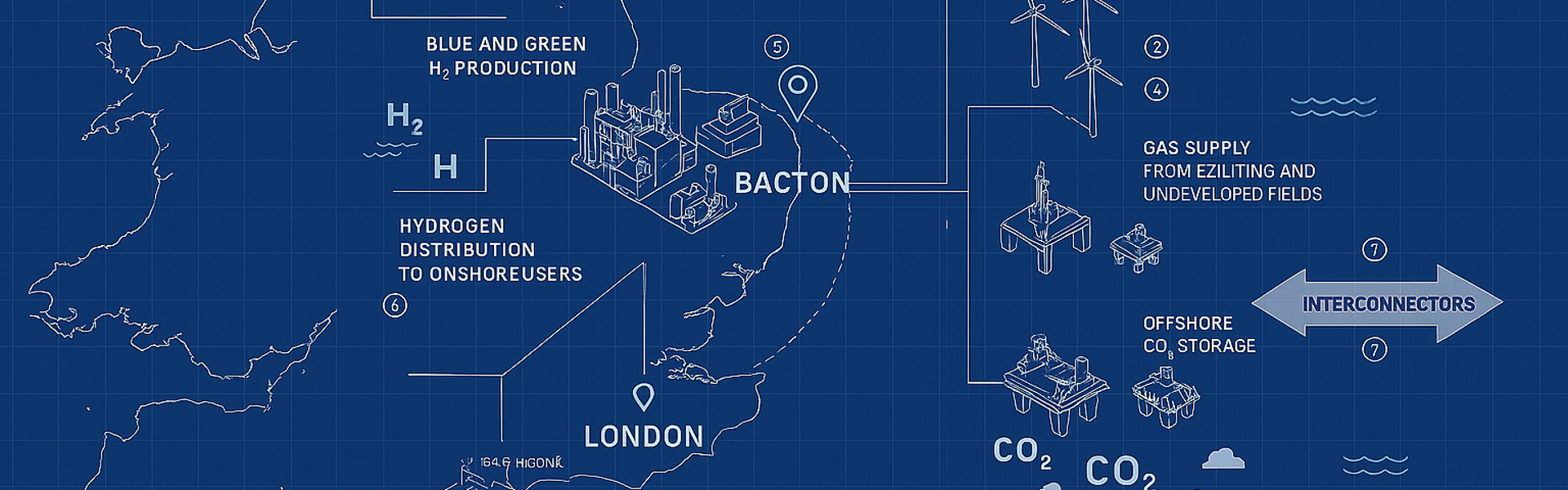
The Bacton CCS Project, led by Eni CCUS Holding, aims to decarbonise industrial processes in the East of England and Thames Estuary area, near London, by means of capturing and storing CO2. The initiative would decarbonise a number of sectors including power generation and waste disposal and, thanks to its location, has the potential to offer decarbonisation solutions to CO2 emitters from north-west Europe.

Eni CCUS intends to achieve initial CO2 injection as part of its Bacton CCS Project by 2030, with potential to reach up to 10 million tonnes per annum (mtpa) in the 2030s.
There is potential for the Bacton Compression Station to be connected to new pipelines from local industrial clusters and via shipping routes or offshore pipeline from Isle of Grain and north-west Europe.
CO2 would be transported from Bacton to the Hewett Reservoir, thought to be capable of storing 300m tonnes.
Eni CCUS has executed non-binding agreements with industrial emitters.
Bacton CCS could also enable low-carbon hydrogen production consistent with the NSTA-supported Bacton Energy Hub concept.
All information on this page has been provided by the relevant owners/operator and should not be taken as an endorsement by the NSTA.
Last updated: 02/07/2026