Digital technologies have an increasingly strong presence in operators’ technology plans, with 28 out of the 38 operators reporting technology targets in this category.
Cloud data management and advanced analytics, including machine learning, have been successfully introduced to better exploit existing reserves.
‘Connected worker’ technologies enable on-site crews to exchange technical and inspection data in real-time in the field via mobile networks using ATEX rated tablets and head-up displays. This technology is becoming business as usual.
Remote and non-intrusive inspection techniques combine with airborne drone and robotic crawlers to provide remote data collection and monitoring systems. These are critical for successful asset management strategies such as in predictive maintenance, removing the need for some offshore manned operations, and reducing manned hazardous area/confined space entries.
Digital and data technologies
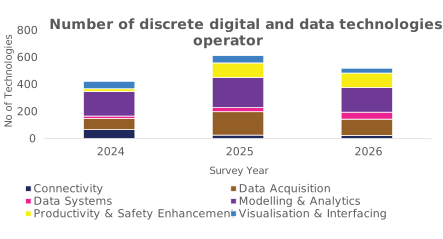
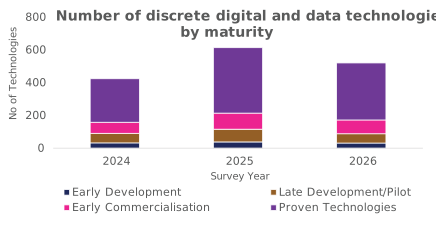
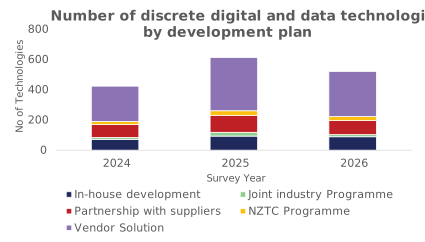
Digital and data applications are one of the strongest areas of interest according to operators’ technology plans, though the number of technologies submitted this year was down slightly, to 522 from 614 the previous year.
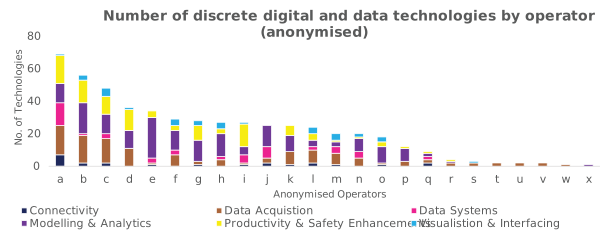
There is broad industry participation, with 24 operators (63% of total respondents) having reported interest in digital technologies.
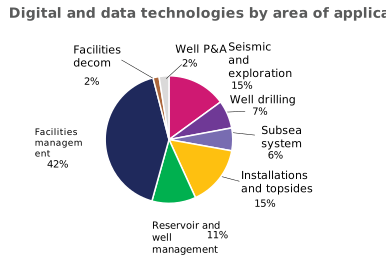
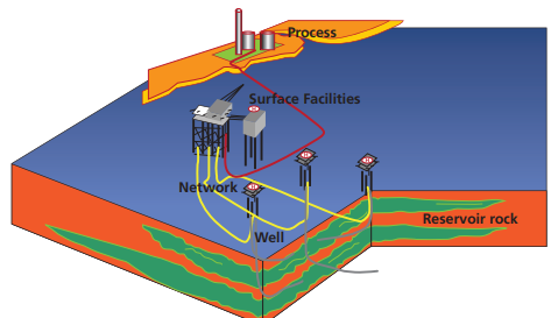
Digital and data is defined in this document as a ‘cross-cutting’ category, in which digital and data are integral parts of technology solutions in most areas of the offshore asset lifecycle (chart below). As such, technologies may appear in this section as well as in one of the other categories.
A third of digital and data technologies in operators’ plans are still under development (early development/late development/pilot), which shows a good pipeline of new technology is coming through. Equally, 67% are proven technologies, which shows this is a well-established area.
Whilst the majority of technologies are provided and deployed by vendors, in 37% of cases operators have taken an active role in the development or customisation. of the solutions for their assets’ needs.
Readiness definitions: Early development (TRL 1-4), late development/pilot (TRL 5-7), early commercialisation (TRL 8), proven (TRL 9)
Operators continue to adopt ‘connected worker’ technologies to enable on-site workers to communicate, receive and record data in the field via mobile networks. New reported technologies this year include maintenance mobility – an operator’s programme that equips frontline maintenance technicians with intrinsically safe industrial tablets, and maintenance and operations optimisation ‘connected worker’ technology providing plant heat maps and early warning notifications. Newly reported emerging technologies include a cloud-hosted Ex inspection system for hazardous area applications.
- Maintenance mobility: Maintenance mobility is an operator’s programme that equips frontline maintenance technicians with intrinsically safe industrial tablets so they can prepare, execute, and close out maintenance work directly at the job site, rather than travelling back and forth to site offices or control rooms.
- TRL 9 commercially available (New)
- Maintenance and operations optimisation: ‘Connected worker’ technology providing plant heat maps and early warning notifications.
- TRL 8 early commercialisation (New)
- Ex Inspection software: A cloud-hosted Ex inspection system for hazardous area applications. Field based data collection uses mobile auto-ID technology such as RFID tags alongside strategies such as RBI to increase compliance and decrease costs.
- TRL 1-4 early development (New)
New deployable technologies reported this year include a GHG and sustainability reporting platform providing structured workflows, real time validation, and enhanced accuracy for emissions and sustainability data, software to integrate different datasets (wellbore, heavy minerals, seismic, geology) to enable real-time update of geological models during drilling, a portable multiphase sampling system, an ultra-high temperature (UHT) noise log tool, and field trials of UDAR technology to support geosteering efforts.
- GHG and sustainability reporting platform providing structured workflows, real time validation, and enhanced accuracy for emissions and sustainability data across operated assets and NOJVs.
- TRL 9 commercially available (New)
- Software to integrate different data sets including wellbore, heavy minerals, seismic, geology, to enable real-time update of geological models during drilling.
- TRL 9 commercially available (New)
- Portable multiphase sampling system to catch and detect the phase of production fluid.
- TRL 9 commercially available (New)
- Well diagnostic tool: Ultra-high temperature (UHT) logging memory tool capable of operating at temperatures up to 572°F for various well diagnostic studies, including well integrity evaluation, production performance and reservoir monitoring. This tool measures acoustic spectrums from 8 Hz to 60,000 Hz with very high-frequency resolution.
- TRL 9 commercially available (New)
- Deployment of ultra-deep azimuthal resistivity (UDAR) geostreering technology: Field trials of UDAR technology to support geosteering efforts. Tool run in three wells so far to aid decision making in real time. Fourth well in planning.
- TRL 8 early commercialisation (New)
Technology example:
The SoundTrak™ service employs proprietary acoustic technology to directly measure valid formation slowness. Multi-frequency excitation ensures high data quality in both fast and slow formations, as well as in a wide range of hole sizes. These measurements can be used for a variety of real-time and post-well applications.

New this year are an early warning radar system to detect errant vessel movements and mitigate collision risk, the latest supervisory monitoring and control system (SMACS) full hardware and software replacement, and a tailored management of change (MoC) automated workflow solution to improve the existing engineering delivery process.
- Early warning radar system: System deployed offshore to detect errant vessel movements and mitigate collision risk.
- TRL 9 commercially available (New)
- Supervisory monitoring and control system / master control system (SMACS / MCS) replacement: Latest system, full hardware and software replacement to preserve availability and improve reliability until end of field life.
- TRL 9 commercially available (New)
- Implementation of management of change (MoC) software: Operator implemented a tailored MoC automated workflow solution to improve the existing engineering delivery process. The previous system utilised manual Excel and paper forms to manage the MoC process requiring increased staff time and was prone to human error.
- TRL 9 commercially available (New)
Newly reported technologies include seismic depth imaging using a common reflection angle migration (CRAM) algorithm to improve the seismic image quality, reverse time migration (RTM) re-imaging of field and surrounds, towed streamer joint 4D FWI to create high resolution (25 Hz) Vp models, digital core analysis workflow, multi-sensor digitalisation of rock cores to create high-resolution, continuous logs at centimetre scale, and a dynamic process simulation model to calculate and monitor combustion efficiency in flaring operations.
- Common reflection angle migration (CRAM): Seismic depth imaging using a CRAM algorithm to improve seismic image quality. This is a multi-pathing depth imaging algorithm that works natively in the subsurface incidence angle domain.
- TRL 9 commercially available (New)
- Reverse time migration (RTM) re-imaging of fields and surrounds using the process of converting the high resolution FWI velocity model directly into a seismic image instead of performing conventional migration imaging, i.e. Kirchhoff migration. The key to this is providing a high frequency detailed velocity model (conventional velocity model building is limited to 7-8 Hz whereas FWI model building takes this to 40 or 50 Hz).
- TRL 9 commercially available (New)
- Towed streamer joint 4D FWI: Create high resolution (25 Hz) Vp models for each vintage for improved ‘gather flatness’ and imaging for input to a LSM migration. Create FWI imaging volumes including 4D FWI images to supplement 4D seismic volumes for interpretation. Therefore, a maximum frequency of 25 Hz for 4D FWI was achieved to allow for FWI imaging.
- TRL 9 commercially available (New)
- Digital core analysis: A multi-sensor digitalisation of rock cores workflow to create high-resolution, continuous logs at centimetre scale. Captures geochemistry, sedimentology, rock mechanics, and petrophysics in a single integrated dataset. Enables rapid lithofacies identification using AI algorithms before destructive sampling.
- TRL 9 commercially available (New)
- Dynamic process simulation model for flares to calculate and monitor combustion efficiency in flaring operations, including CO2e, methane measurement, flare combustion and destruction efficiency.
- TRL 8 early commercialisation (New)
New this year are oil metering upgrades to ensure representative and homogenous sample flows, a reusable plug that can be set multiple times in a single intervention run, and automated production optimisation options. Emerging technologies include a digital tool for planning and optimising subsea campaigns, scheduling, planning, and costs/budget KPIs.
- Oil metering upgrade: Upgrade of three test oil metering flow meters to ultrasonic flow meters to improve accuracy. The existing and conventional 'fast loop' analyser sampling arrangements on all three production trains are also to be replaced to ensure a representative and homogenous sample flow through the analytical systems. This technology utilises a unique liquid jet in cross flow configuration, which in turn delivers practically infinite turndown in flow rates while also ensuring zero pressure drop.
- TRL 9 commercially available (New)
- Reusable plug that can be set multiple times in a single intervention run to enable flow trials to test water shut off operations. Alternative to PLT in selected wells.
- TRL 9 commercially available (New)
- Operator training simulations (OTS): High-fidelity digital twins of refineries and production facilities designed to train control room operators and technicians in a safe, realistic environment.
- TRL 9 commercially available (New)
- Remote operation centre to control autonomous surface vessels (ASVs).
- TRL 8 early commercialisation (New)
- Automated production optimisation (APO) options for automated well control, automated process control, automatic well testing, for automatic gas lift optimisation, rate allocation, including a flowrate soft sensor.
- TRL 8 early commercialisation (New)
Technology example:
The concept of integrated production modelling (IPM) was pioneered by petroleum experts and it involves the elimination of artificial boundary conditions. A change that is made on a pipeline model for example, will automatically change the behaviour of the wells and reservoirs upstream of that pipe, as well as behaviour of all the elements downstream.
- Digital tool for planning and optimising subsea campaigns, scheduling, planning, costs/budget KPIs.
- TRL 1-4 early development (New)
Seismic reprocessing with full waveform inversion (FWI) is new to this year’s report. New/emerging technologies include the next iteration of remote audio-visual inspection for DVI, with a focus on artificial intelligence and machine learning, and AI tools for P&A to allow quicker and more efficient planning/preparation.
- Seismic reprocessing with full waveform inversion (FWI): Legacy seismic has a significant drop in vertical resolution in areas overlain by the graben and quaternary channels. FWI solution uses diving waves, refractions and reflections to deliver stable deep velocity model updates without relying on very long offsets.
- TRL 9 commercially available (New)
Technology example:
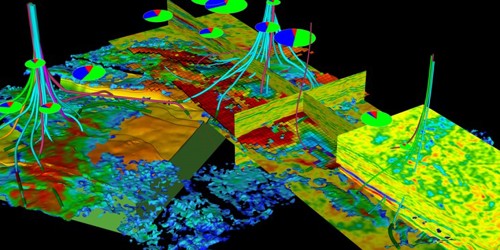
CoViz 4D makes it possible for multi-disciplinary asset teams to simultaneously view and interrogate all available data from seismic to simulation, regardless of the original data source.
- Remote audio-visual inspection: Next iteration of development for DVI, with focus on artificial intelligence and machine learning, and a view to improvement of corrosion monitoring capabilities and fabric maintenance planning/execution.
- TRL 5-7 late development/pilot (New)
- AI tools for P&A to read and interpret scanned well data and EOWRs to allow quicker and more efficient planning/preparation of P&A of mature fields.
- TRL 5-7 late development/pilot (New)