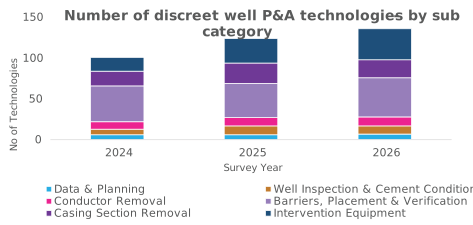
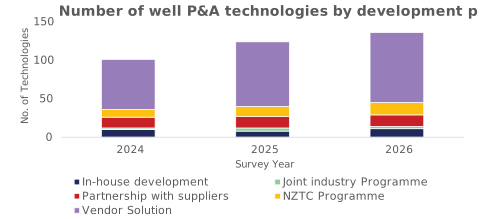
The number of Well P&A technologies reported continues to increase steadily.
Innovation is driven by both vendors and operators and includes through-tubing cement bond logging, barrier placement and downhole wireless sensing.
There has been progress in introducing novel barrier materials and deployment techniques, and tools for removing control lines from downhole gauges.
A number of technologies have been reported including:
- A wellhead connection system designed to quickly connect and disconnect using hydraulics
- A novel cutting tool for dual tubing strings and chrome tubing
- A new single-lift, well-to-well transfer system which eliminates the use of a wireline mast and enhances safety
- Use of a lower cost intervention vessel which can lower P&A costs when compared to the use of LWIVs and standard rigs
Well plugging and abandonment technologies
The number of technologies reported in this category grew again this year, with a notable increase in intervention equipment and barriers, placement and verification technologies.
Key areas of innovation include barrier materials placement and intervention equipment able to reduce the time and cost of P&A operations.
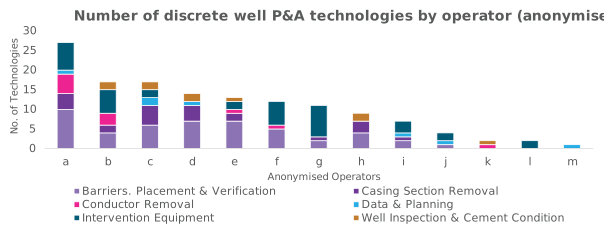
Interest in P&A innovation appears concentrated with 13 operators who have reported technologies in their plans.
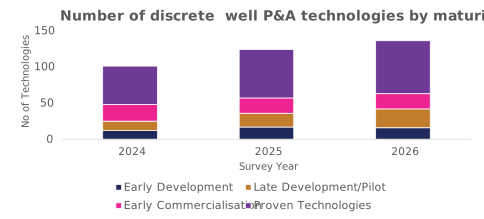
Well P&A is an active field of innovation with 31% of technologies reported in operators’ plans in the early development or late development/pilot phases.
The majority of technologies are provided and deployed by vendors and suppliers. In 21% of cases, operators have taken an active role in the development or customisation of the solutions for their assets’ needs.
Readiness definitions: Early development (TRL 1-4), late development/pilot (TRL 5-7), early commercialisation (TRL 8), proven (TRL 9)
Please refer to the overall technology listing – a downloadable file listing all 1,320 technologies, including previously reported entries, which can be found on the home page of this report (no new technologies this year).
Please refer to the overall technology listing – a downloadable file listing all 1,320 technologies, including previously reported entries, which can be found on the home page of this report (no new technologies this year).
New entries this year include probabilistic, risk based well P&A modelling to confirm whether well P&A risks are ALARP, and a modular compact rig capable of performing P&A operations. New/emerging technologies include plastic deformation of casings to create an environmental well barrier.
- Probabilistic, risk based well P&A modelling to confirm whether well P&A risks are ALARP and identify the potential to reduce expensive well P&A scope.
- TRL 9 commercially available (New)
- Modular compact rig capable of performing P&A operations where derrick/drilling package is unusable due to long term deactivation.
- TRL 8 early commercialisation (New)
Technology example:
NZTC multi-operator collaboration accelerating the rate at which technology is developed, tested and piloted for well decommissioning:
- Alternative barrier materials
- Inspection and verification
- Enabling technologies
Link to technology example:
- Plastic deformation of casings: Potentially more efficient than conventional use of cement for non-pressure retaining environmental well barrier.
- TRL 5-7 late development/pilot (New)
New this year is a system allowing mechanical perforation of casing strings and a campaign approach to wellhead severance using three technologies. Emerging/new technologies include a corrosion accelerator technique to dissolve downhole casing.
- Mechanical perforation system: Allows mechanical perforation of casing strings to expose the annuli for cement remediation and annulus isolation.
- TRL 9 commercially available (New)
- Wellhead severance, triple tech approach: Multi-well campaign supported utilising internal WHS technology abrasive water jet (ABWJ), explosive severance, and mechanical cutter.
- TRL 9 commercially available (New)
Technology example:
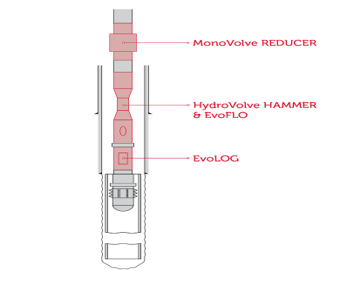
HydroVolve Hammer. Combined pulling and impact forces to break settled solids and shear cement bonds. Combining high overpull forces with high frequency vibration to deliver stuck-object extraction force to remove stuck casing.
- Corrosion accelerator to enable a full rock-to-rock well abandonment barrier including the existing casing preventing access to the annular space.
- TRL 1-4 early development/pilot (New)
New technologies include a tubing-retrievable surface-controlled subsurface safety valve (TRSSSV) tool for locking open the flowtube and flapper, a hydraulically driven slips and cutting module located on the seabed to avoid lifting hundreds of feet of tubing to the surface. Emerging technologies include a tree connector recovery technology to cut and release hydraulic connectors, an AI engineering agent to support data mining in the initial stages of well abandonment planning.
- TRSSSV lockout tool used for locking open the flowtube and flapper, without opening the control line communication port on pre-phase one abandonments.
- TRL 9 commercially available (New)
- Rigless P&A: To avoid lifting hundreds of feet of tubing to the surface, this technology comprises a hydraulically driven slips-and-cutting module located on the seabed with handling using a crane and ROV. The ROV would fly over and hot stab to control cut and slips, etc. Cut tubing joints would be laid out into subsea baskets.
- TRL 9 commercially available (New)
Technology example:
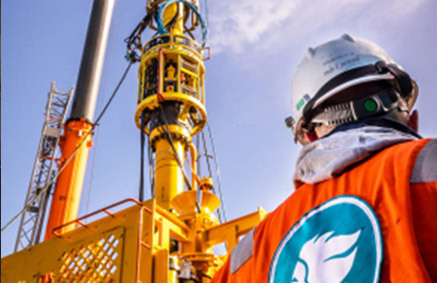
Deployed from a dynamically positioned monohull vessel, the riserless well intervention system (RWIS) provides a reliable solution for carrying out cost-effective intervention and abandonment operations on all types of subsea wells. The RWIS is modular in design, allowing the system to be tailored to specific job requirements
- Tree connector recovery: Technology to cut and release hydraulic connectors. Onshore trials with vendor completed in 2025. Deployment planned for 2026.
- TRL 5-7 late development/pilot (New)
- AI engineering agent to support data mining in the initial stages of well abandonment planning.
- TRL 1-4 early development (New)