Facilities management is a very active area of technology deployment and continuous innovation.
Non-intrusive inspection technologies, advanced analytics software using machine learning and remote/robotic access are being adopted on an increasing number of offshore assets. These technologies can ensure access to hard-to-reach areas, increasing safety and reducing the requirement for manned entries into pressure vessels and storage tanks.
Respondents are reporting the adoption of tailored inspection techniques and maintenance technologies for the complex issues regarding FPSO turrets on floating facilities
There has been a significant increase in the uptake of digital systems for facilities management, with growing adoption of electronic hand-held devices and wireless communication offshore, many becoming business as usual, supporting effective integration with operations and maintenance systems, asset surveys and full digital twin applications.
Facilities management technologies
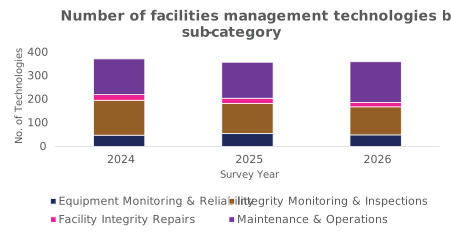
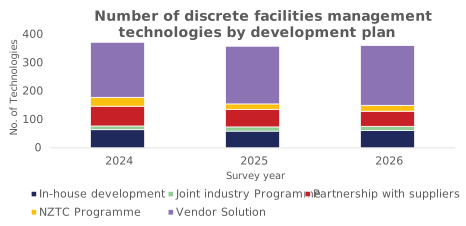
The number of technologies reported was 360 (up from 358 the previous year), as facilities management remains one of the largest focus areas for operators.
Technologies span integrity monitoring, with particular emphasis on non-intrusive inspection (NII), operations management and maintenance.
Growing attention has been focused on technologies related to condition monitoring to achieve greater equipment reliability through predictive maintenance.
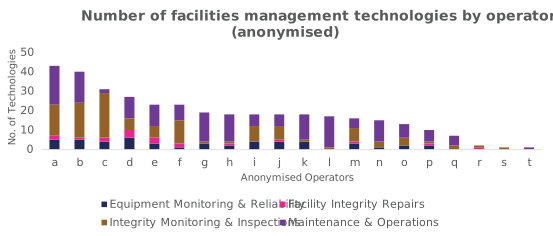
There is widespread industry interest in these technologies, with 17 operators carrying at least five facilities management technologies in their current plans. Twenty operators are reporting one or more technologies.
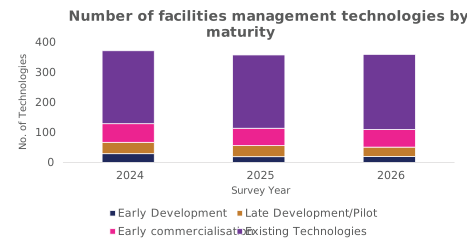
Many technical solutions for facilities management are proven technologies, with circa 14% in the early development or late development/pilot stages.
Whilst the majority of technologies are provided and deployed by vendors and suppliers, in circa 35% of cases, operators have played an active role in the development or customisation of the solutions for their assets’ needs
Readiness definitions: Early development (TRL 1-4), late development/pilot (TRL 5-7), early commercialisation (TRL 8), proven (TRL 9)
New and emerging technologies include a compact cyclonic separator and a cloud-hosted Ex inspection system for hazardous area applications.
- Compact cyclonic separator: Design and lab testing of a full-scale preproduction version of a super-compact separator. A test programme completed at Robert Gordon University Aberdeen in February 2024 was successful and verified all the claimed benefits of the technology.
- TRL 5-7 late development/pilot (New update)
- Ex inspection software: A cloud-hosted Ex inspection system for hazardous area applications. Field based data collection uses mobile auto-ID technology such as RFID tags alongside strategies such as RBI to increase compliance and decrease costs.
- TRL 1-4 early development (New)
New solutions and approaches include reducing gas flaring through process control improvement to an FPSOs flash gas compressor/export gas compression systems, and micro-methane emissions quantification.
- Gas flaring reduction: Process control improvements to an FPSOs flash gas compressor/export gas compression systems which reduced flaring from 2.5MMSCFD to 0.3MMSCFD (dependent on the flash gas compressor availability).
- TRL 9 commercially available (New)
- Methane emissions: Micro-methane emissions quantification.
- TRL 8 early commercialisation (New)
Technology example:
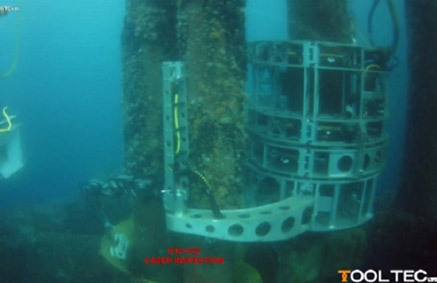
ToolTec has developed a range of cleaning and inspection tools that can be deployed from a platform, capable of cleaning and obtaining inspection data from varying sizes of caissons and conductors.
New technologies include laser scanning for engineering/repairs, and a permanently installed monitoring system using ultrasonic techniques for erosion monitoring.
- Erosion monitoring: Permanently installed monitoring system using ultrasonic techniques.
- TRL 9 commercially available (New)
- Laser scanning for engineering/repairs: Remote or digital visual inspection using model data developed from laser scanning data/images to enable surface corrosion and conditions to be mapped and assessed from onshore or remotely, whilst also reducing POB impact and footprint to execute a number of inspection scopes.
- TRL 8 early commercialisation (New)
New this year are an early warning radar system to detect errant vessel movements and mitigate collision risk, environmental accounting software that simplifies reporting, a GHG and sustainability reporting platform providing structured workflows, real time validation, and enhanced accuracy for emissions and sustainability data, a process safety barrier model to aid risk-based decisions, and maintenance and operations optimisation using ‘connected worker’.
- Radar early warning system: System deployed offshore to detect errant vessel movements and mitigate collision risk.
- TRL 9 commercially available (New)
- Environmental accounting software that simplifies reporting for offshore oil and gas operators.
- TRL 9 commercially available (New)
- GHG and sustainability reporting platform: Providing structured workflows, real time validation, and enhanced accuracy for emissions and sustainability data across operated assets and NOJVs.
- TRL 9 commercially available (New)
- Process barrier safety model: Using computerised maintenance management system (CMMS) data and putting RBI inspection integrity records into a visualisation tool to aid risk-based decisions.
- TRL 8 early commercialisation (New)
- Maintenance and operations optimisation: Using ‘connected worker’, plant heat maps and early warning notifications.
- TRL 8 early commercialisation (New)
Technology example:
EPIC have been supplying reliable and effective POB solutions to the marine, oil and gas sector for over 30 years. Our client list of oil majors and market leaders throughout the world speaks for itself.