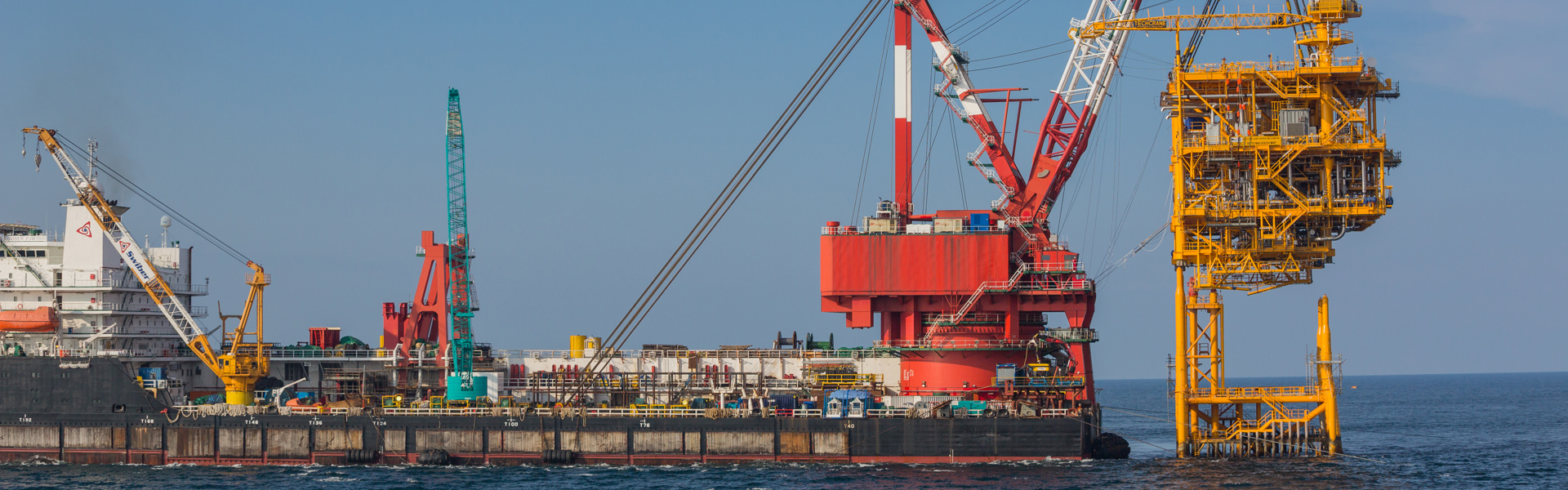
Operators continue to focus on cost-effective installation solutions to support development of more marginal hydrocarbon resources.
Emission reduction is a priority, with improved operational monitoring and controls leading to power management efficiencies and reductions in flaring and venting.
Emission reduction technologies include:
- Onshore smart rooms for remote operations
Remote inspection systems to reduce need for manned operations - Innovative turret maintenance technologies to reduce need for off station work
- Hybrid power systems
- Waste heat recovery
- Fugitive gas leak monitoring of valves and pipework
- Flare combustion efficiency monitoring
- Flare gas recovery
- Vapour recompression to capture flash gas
Installations and topsides technologies
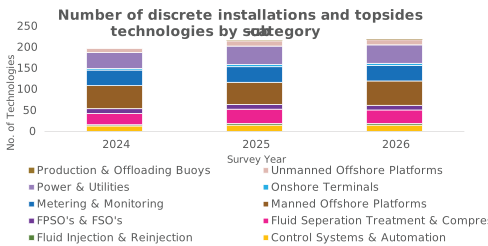
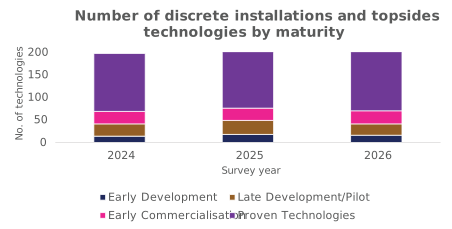
Operators reported 218 technologies related to design and equipment for surface installations in 2026, the second largest category after facilities management.
Operators’ focus includes:
- Process equipment able to cope with more complex fluid compositions
- Facilities monitoring and remote operations
- Increasing attention on power efficiencies and emission reduction
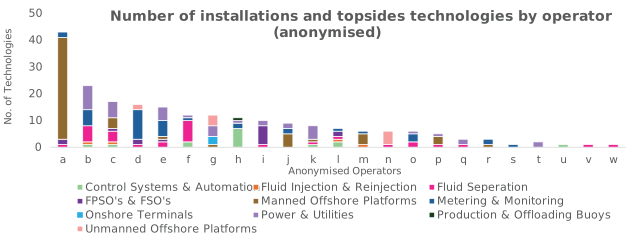
Sixteen operators have at least five topsides technologies in their current plans, and seven more operators report at least one technology.
Operators are focusing on commercially available technologies, but 32% of technologies are in early development, late development/pilot or early commercialisation stages.
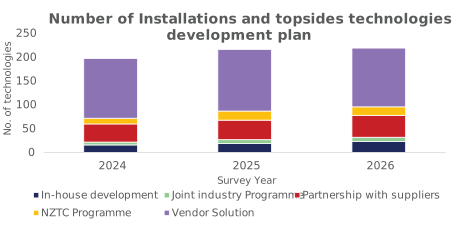
Industry relies on vendors to source technologies for new facilities and facility upgrades.
Operator-vendor partnerships (22%) address specific facility requirements for green-field projects and asset upgrades including emission reduction modifications.
Readiness definitions: Early development (TRL 1-4), late development/pilot (TRL 5-7), early commercialisation (TRL 8), proven (TRL 9)
New technologies and approaches reported this year include switchgear remote racking equipment, metering server upgrades to replace obsolescent equipment with new vendor technical solution
- Switchgear: Safe remote racking equipment.
- TRL 9 commercially available (New)
- Metering server upgrades to replace obsolescent equipment with new vendor technical solution.
- TRL8 early commercialisation (New)
Technology example:
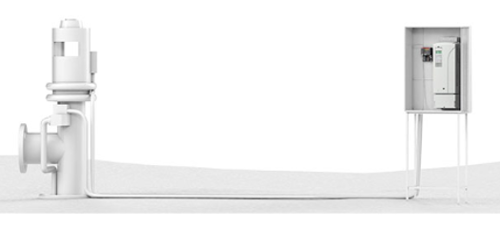
ABB automated control system for ESPs
Please refer to the overall technology listing – a downloadable file listing all 1,320 technologies, including previously reported entries, which can be found on the home page of this report (no new technologies this year).
New this year are hydrate kinetic modelling to allow platforms MEG free operation using a risk-based hydrate management approach, and CO2 capture using hot potassium carbonate at power stations.
- Flow assurance revision with hydrate kinetic modelling using a risk-based hydrate management approach, supported by dynamic flow assurance using OLGA, to allow MEG free pipeline operation.
- TRL9 commercially available (New)
- CO2 capture using hot potassium carbonate at power station.
- TRL 8 early commercialisation (New)
Technology example:
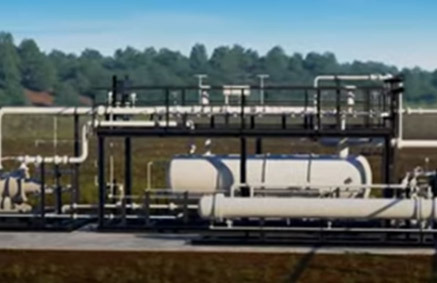
A flare gas recovery unit (FGRU) is a system that captures flare gases and redirects them back into production workflows for reuse as fuel gas. This process helps to reduce routine flaring and emissions while saving operators on long-term production costs.
New this year are a turret swivel with a higher voltage rating than currently available and an IR sensor attached to an unmanned aerial system (UAS). Emerging technologies include technical qualification of mooring system components for large FPSO developments.
- High voltage swivel to improve the feasibility of facility electrification.
- TRL 8 early commercialisation (New)
- IR sensor attached to an unmanned aerial system (UAS): Methane emissions survey conducted using drone flight survey. Gathering of baseline data in support of an installation’s methane action plan.
- TRL 9 commercially available (New)
- Mooring system components: Technical qualification of hardware for large FPSO developments.
- TRL 5-7 late development/pilot (New)
New technologies this year include per- and polyfluoroalkyl substances (PFAS) free firefighting foam, and a bow-tie digital product that supports self verification. Emerging technologies include CUI risk management using an improved inspection methodology to enhance risk management.
- Fluorine-free firefighting foam: Per- and polyfluoroalkyl substances (PFAS) free firefighting foam to replace AFFF (contains PFAS compounds) to fight fires. Replacement fluorine free foams are being developed and qualified, however, there are certain applications that are yet to identify a suitable replacement.
- TRL 9 commercially available (New)
- Bow-tie: Digital product that supports self verification, oversight and evaluation for marine, supply base, aviation and land transportation. The current processes for creating question sets, evaluating completion, scheduling audits and checks, and delivering metrics on completion is undertaken in the same system.
- TRL 9 commercially available (New)
- CUI risk management: Supporting trials of new technology to improve inspection methodology. If successful, would allow assessment of pipework condition without the need for insulation removal.
- TRL 1-4 early development (New)
New this year are a dynamic process simulation model to calculate and monitor combustion efficiency in flaring operations, a high frequency radar level detector to provide reliable level measurement in a drains vessel, industrial internet of things (IIOT) methane spectrometers that assess thermodynamic properties, e.g. gas density, at different temperatures. A stationary combustion equipment predictive emissions monitoring system is a new/emerging technology.
- Dynamic process simulation model to calculate and monitor combustion efficiency in flaring operations including CO2e and methane measurement and flare combustion and destruction efficiency.
- TRL 8 early commercialisation (New)
- Radar level detector: A high frequency detector to provide reliable level measurement in a drains vessel which does not require a guidance tube which is susceptible to blocking up.
- TRL 9 commercially available (New)
- Methane spectrometers: Industrial internet of things (IIOT) methane spectrometers that assess thermodynamic properties, e.g. gas density, at different temperatures. Including a network of IIoT wireless sensors, and converting information into concentration, available through specific PI dashboards.
- TRL 9 commercially available (New)
- Stationary combustion equipment: Stationary combustion equipment for a predictive emissions monitoring system. Deployed on an offshore export/booster compressor. Predictive emissions monitoring system based on existing process parameters such as pressure, temperature, flow rates and exhaust stack testing results using mathematical models, available through a specific dashboard.
- TRL 1-4 early development (New)
Technology example:
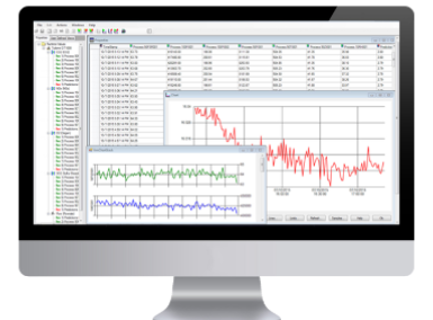
ABB PEMS to improve efficiency and streamline emissions reporting. ABB offer the PEMS solution
| Technology Example: | |
|---|---|
|
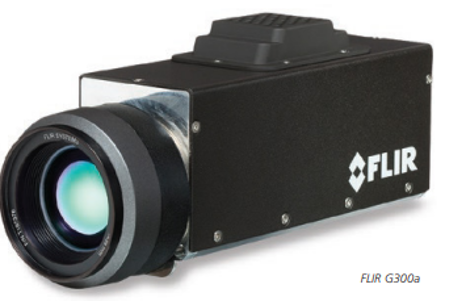
FLIR camera: The FLIR G300 is an optical gas imaging (OGI) camera that visualises gas, so you can monitor installations in remote or hazardous areas for gas leaks, hydrocarbon or volatile organic compound (VOC) leaks. Cameras are widely used in industrial settings, such as offshore platforms.
|
 |
Newly reported this year are an organic Rankine cycle electricity generator, development of a grid tie-in for platform electrification including conversion of AC to HVDC for transmission in a subsea HVDC cable to an offshore substation, and a high energy flare ignition package.
- Organic Rankine cycle electricity generator to utilise waste heat from the hot-oil and gas engine power generation hot-water heat recovery systems.
- TRL 9 commercially available (New)
- Flare ignition: A high energy flare ignition package to improve reliability of flare lighting.
- TRL 9 commercially available (New)
- Platform electrification (power supply): Development of a grid tie-in for platform electrification including conversion of AC to HVDC for transmission in a subsea HVDC cable to an offshore sub-station.
- TRL 9 commercially available (New)
Please refer to the overall technology listing – a downloadable file listing all 1,320 technologies, including previously reported entries, which can be found on the home page of this report (no new technologies this year).