



For decades, the UK’s oil and gas industry has spearheaded the development of pioneering technologies used to safely and responsibly produce billions of barrels of oil and gas, both domestically and overseas, supporting energy security.
Innovative technologies developed in the UK will also support the energy transition, helping cut emissions from oil and gas operations and accelerating the development of emerging industries, such as carbon storage (CS) and hydrogen.
The NSTA raises awareness of technologies which are having a positive impact and accelerates their deployment across the North Sea. Through an annual survey and technology plans, operators submit information to the NSTA about new technologies they are trialling, or have recently installed, and their efforts to identify innovative solutions which could enhance operations in future.
The NSTA’s technology experts analyse this valuable information and use it to generate insights which are included in its annual Technology Insights Reports. This consolidated view of technology deployment by operators is an important indicator of the industry’s ability to meet current and future demand and helps identify priority areas.
Thirty-eight UKCS licensees completed the annual technology survey and submitted technology plans to the NSTA by the end of February 2026.
There was strong evidence of a continuing focus on technologies for the cost-efficient production of hydrocarbons and the reduction of emissions across the full lifecycle.
To download a file containing a list of operators' technology needs, click here, and for a comprehensive listing of technology solutions reported in 2026, click here.
Notable examples:
Drilling and well construction
- Low-cost platform modular drilling rig systems
- Single-lift, well-to-well transfers
- Logging-while-drilling sonic logging for top of cement identification
- Digital well planning using AI
- Tubing retrievable surface controlled subsurface safety valve

Facilities design and inspections
- High frequency vibration and axial data analysis
- Cost-efficient pipelines and longer tiebacks
- Subsea gas compression and multiphase boosting
- Non-intrusive inspection technologies
- AI for risk-based inspection systems
- Controls and automation

Well intervention
- Wireless downhole surveillance technologies
- Disposable fibre-lines
- Retrofit DHSVs and ESPs
- Flexible zonal isolation solutions
- Real time slickline and coiled tubing solutions
- Water shut-off solutions

Emission reduction
- Flare gas recovery systems
- Vapour recovery systems
- Enhanced emissions monitoring, including fugitives and flare efficiency measurement
- Electrification
- Hybrid energy systems
- Emissions monitoring during wells activities

Technology survey and plans
Operators referenced 1,320 innovative solutions in the technology section of the UKCS Stewardship Survey, and in their technology plans, by the end of February 2026, up from 1,280 the previous year.
This year 189 new technologies were reported, up from 142 last new technologies last year.
Solutions used by an operator on more than one asset have been counted only once. Technologies which featured in previous reports, but are now considered mainstream, are not included in this year’s edition, neither are tools which failed to progress past screening and pilots.
About 41% of technologies were reported in categories relating to new asset developments, 43% were in operations categories, and 16% were for decommissioning.
The proportion of technologies reported for installations and topsides was consistent with previous years.
Digital and net zero themes are becoming more focused on operational functions.
Number of technologies reported (UKCS operators)
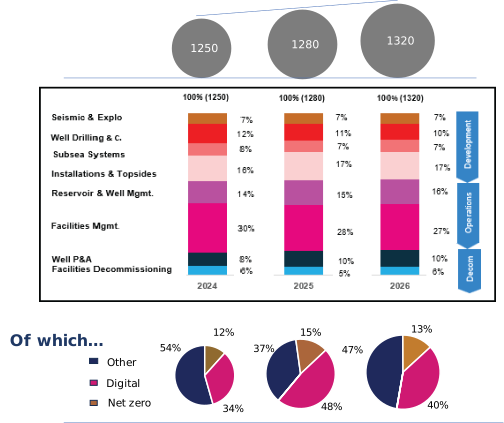
Image Description Number of technologies reported (UKCS operators)
Operators’ technology uptake and sources
- The focus on active technology management among UKCS operators has remained consistent over the last three surveys.
- Eighteen operators reported more than 10 distinct technologies this year.
- More than half of the technologies (60%) are sourced directly from vendors/suppliers.
- However, in 22% of the cases, operators actively partner with selected suppliers to develop solutions in partnership, and/or from joint industry projects.
- The Net Zero Technology Centre’s (NZTC) contribution to supporting and facilitating technology innovation was consistent.
Number of technologies reported by operator
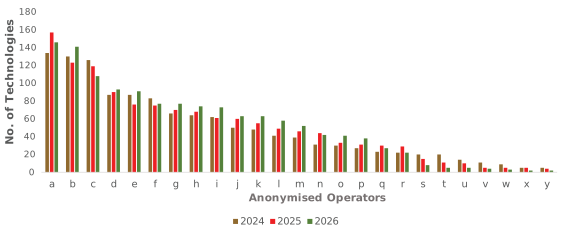
Image description - Number of technologies reported by Operator
Technology sourcing
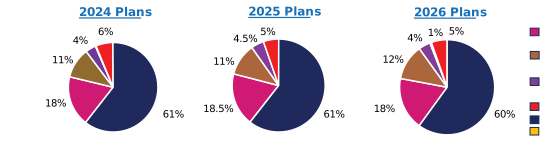
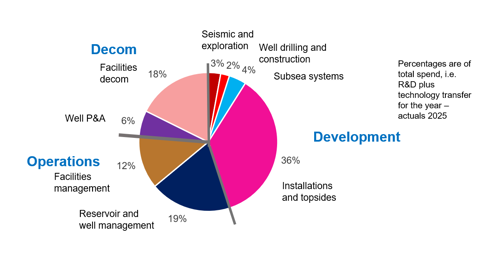
Direct spend on technology
- Operators make a sizeable contribution to technology research and development (R&D) for UKCS needs.
- In 2025, £77m of direct R&D spend is targeted, this is comparable to previous years, but less in real terms than a decade ago (Note: These are “money of the day” values (not factored for inflation).
- The forecasted Technology Transfer spend (defined as the cost to deploy the technologies in the field) continues to increase as the direct R&D expenditure remains more constant.
- Development categories attract the largest proportion of operators technology spend (61%).
Direct spend on technology
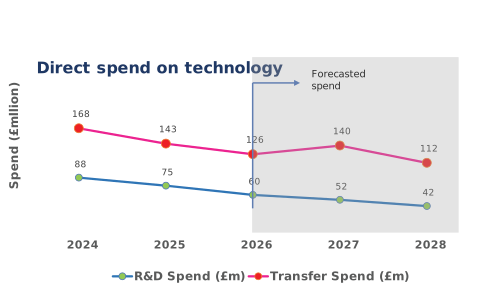
Download
Click to on the items to download.
Download
Click to on the items to download.