Operators’ technology plans reflect industry priorities to reduce offshore greenhouse gas emissions.
With a number of carbon storage licences and permits awarded, innovative technologies are being developed for site characterisation, well and facility design, monitoring, measurement and verification of CO2 injection.
Reduction of flaring and venting emissions are targeted, for instance, through technologies able to recover flash gas and/or improve flare combustion efficiency.
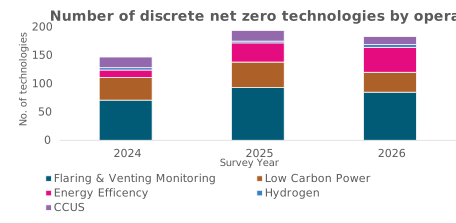
Operators are actively reducing power generation emissions through more efficient equipment, alternative fuels, hybrid power systems, and replacing conventional power generation with renewable power from offshore wind farms or from shore.
Technology survey data is showing continued reporting of hydrogen production related technologies (three instances).
Net zero technologies
In line with industry commitments to reduce greenhouse gas emissions, interest in technologies to address flaring and venting, energy efficiency.
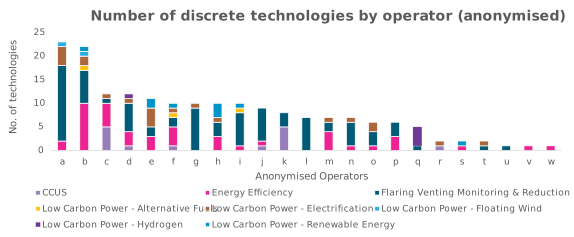
Companies with the largest operational footprint in the UKCS show greatest interest, but in general there is a broad presence of these technologies in the reported plans (23 operators out of 38).
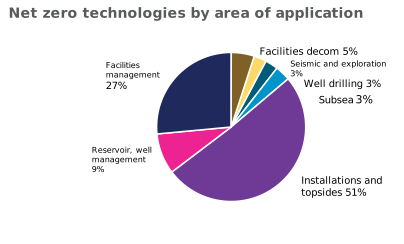
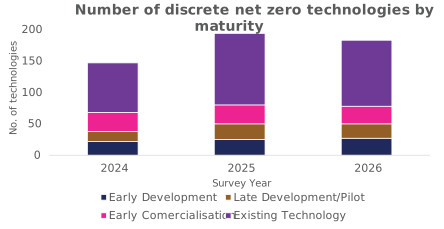
Net zero is defined in this document as a ‘cross-cutting’ category, where technologies are an integral part of the offshore asset lifecycle (chart below). As such, technologies may appear in this section as well as in one of the other categories.
Technology solutions for net zero applications tended to be less proven than in other more mature categories, but in the latest survey 27% are reported at early development or late development/pilot stage, while the rest are at existing or early commercialisation maturity levels.
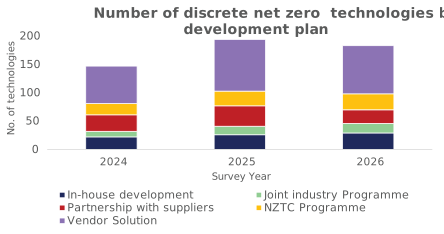
Operators are getting more involved directly in the technology development cycle in this area either in-house or in partnership with vendors or the Net Zero Technology Centre (53%).
Readiness definitions: Early development (TRL 1-4), late development/pilot (TRL 5-7), early commercialisation (TRL 8), proven (TRL 9)
Cameras to detect flare flame out, a high energy flare ignition package to improve reliability of flare lighting, industrial internet of things (IIOT) methane spectrometers, and a dynamic process simulation model to calculate and monitor combustion efficiency in flaring operations are new to the report this year. Emerging technologies include stationary combustion equipment for a predictive emissions monitoring system (PEMS).
- Flare flame detection cameras: Thermal Infra-Red (IR) cameras installed for methane permanent monitoring to detect flare flame out.
- TRL 9 commercially available (New)
- Flare Ignition: High energy flare ignition package to improve reliability of flare lighting.
- TRL 9 commercially available (New)
- OLGA well transient modelling: Modelling of unloading and test operations during well completion phase to optimise operations and minimise flaring.
- TRL 9 commercially available (New)
- Industrial internet of things (IIOT) methane spectrometers: Fugitive emissions measurement using a network of IIoT wireless sensors including molecular property spectrometers that measure thermodynamic properties such as gas density at different temperatures. Output available through specific PI dashboards.
- TRL 9 commercially available (New)
- Dynamic process simulation model for flares to calculate and monitor combustion efficiency in flaring operations, including CO2e, methane measurement, flare combustion and destruction efficiency.
- TRL 8 early commercialisation (New)
- Stationary combustion equipment for a predictive emissions monitoring System (PEMS). Deployed on an offshore export/booster compressor based on existing process parameters such as pressure, temperature, flow rates and exhaust stack testing results using mathematical models, available through a specific dashboard.
- TRL 1-4 Early development (New)
New this year is a high voltage swivel, and emerging technologies include hydrogen storage, and evaluation of impact to swivel stack and feasibility of implementing a HVAC electrical swivel.
- Platform electrification (power supply): Development of a grid tie-in for platform electrification including conversion of AC to HVDC for transmission in a subsea cable to an offshore substation.
- TRL 9 commercially available (New)
- High voltage swivel to improve the feasibility of facility electrification.
- TRL 8 early commercialisation (New)
- Offshore hydrogen storage: NUI redevelopment of facilities with storage volumes staged increases to match demand.
- TRL 5-7 late development/pilot (New)
- Electrification of FPSO: Evaluation of impact to swivel stack and feasibility of implementing a HVAC electrical swivel path has been commenced.
- TRL 1-4 early development (New)
New this year is a remote operation centre supporting autonomous surface vehicles (ASVs). Emerging technologies reported include topsides re-use, a corrosion accelerator technique to dissolve downhole casing, AI engineering agent to support data mining in the initial stages of well abandonment planning.
- Remote operation centre to control autonomous surface vessels (ASVs).
- TRL 8 early commercialisation (New)
- Topsides re-use to avoid scrapping facilities.
- TRL 1-4 early development (New)
- Corrosion Accelerator to enable a full rock-to-rock well abandonment barrier including the existing casing preventing access to the annular space.
- TRL 1-4 early development (New)
- AI engineering agent to support data mining in the initial stages of well abandonment planning.
- TRL 1-4 early development (New)
CO2 capture using hot potassium carbonate at power station is a new entry.
- CO2 capture using hot potassium carbonate at a power station: Before entering the core of the capture cycle, the flue gas heat is recovered, utilising a pressurised clean gas absorber stream to generate an overall surplus of electricity. Compared with a typical combined cycle gas turbine plant (CCGT), this system provides a low-cost, less complex, and high capture rate alternative. The overall cooling demand is also lower, and the capture plant can provide valuable heat at 30-105 °C if required.
- TRL 8 early commercialisation (New)